

ASTRUM DRIVE
Aerospace
Fuel Free Space Propulsion
The World’s First Propellantless, Electricity-Only Space Propulsion System
Demonstrated, tested, peer reviewed, patented. No fuel. No propellant.
At Astrum Drive Technologies, we’ve developed a propulsion system that produces real, measurable thrust using only electricity — no propellant and no fuel tanks.
Backed by peer-reviewed research, multiple patents, and TRL 6–7 prototypes, our technology unlocks a new era of extended satellite operational lifespans, lower launch mass, and continuous maneuverability.
THE PROBLEM
For more than 70 years, space propulsion has depended on fuel.
Fuel limits how long satellites live, how far we can travel, and how much cargo spacecraft can carry.
Satellites typically die after 5–10 years, mostly because they run out of propellant.
Every kilogram of fuel requires exponential launch mass (rocket equation).
Launch cost: $10,000–$20,000 per kg to low Earth orbit.
A propulsion system that removes fuel from the equation changes everything.
OUR SOLUTION
Astrum Drive: Propellantless Electric Propulsion
100% electric: no propellant, no consumables
Demonstrated thrust: 50 mN continuous in controlled lab and field tests, enough to keep any satellite in orbit
Extended operational lifetime – no longer constrained by propellant depletion.
Compact, lightweight, and scalable.
How It Works
Our patented process uses an innovative application of thermodynamics to generate usable thrust from electricity alone. The core mechanism is a highly controlled phase-change cycle – liquid to gas and back to liquid – a critical thermodynamic process known to produce complex momentum-transfer effects. Because the conservation of momentum is maintained through internal gradients of these phase transitions, the system can generate directed thrust while remaining closed for mass transfer but stays open for energy transfer.
Importantly, phase-change fluid dynamics cannot be fully described using Newton’s laws alone; even today, the mathematical description of such systems remains one of the greatest unsolved problems in physics and mathematics – the Navie-Stokes equations. Despite this complexity, our system for inducing and regulating the phase-change cycles has been repeatedly validated with over 100 independent measurements, demonstrating consistent and controllable thrust.
We published a peer-reviewed article in a top-tier engineering journal explaining the physics behind our propellantless space propulsion system
LAB VALIDATION
Laboratory-Verified Propulsion Demonstration
Objective
Verify that the Astrum Drive generates measurable thrust in a sealed, vibration-isolated laboratory environment using only electrical power.
Hypothesis
If the drive operates as predicted, activating it will create a measurable increase in apparent weight (downward thrust) that exceeds the background noise of the measuring instrument.
Experimental Setup
Environment: Certified, vibration-isolated lab with no airflow.
Measurement device: Ultra-sensitive precision scale (millinewton resolution).
Mounting configuration:
-
- The system rests on a single metal ball bearing to eliminate mechanical bias.
- The top is tethered to remove lateral motion and isolate vertical force.
Baseline: Scale is calibrated to zero before power-on.
Procedure
Power applied at 0:01
System reaches full power at 6:09
Partial power-off at 6:56
Complete shutdown at 9:59, after thermal energy dissipates.
Scale returns to exact baseline zero after the system is shut down, confirming no mass loss or gain occurred during the operational phase.
Results
Continuous thrust: ~12 mN at full power.
Signal-to-noise ratio: >1000×
Thrust appears almost immediately, indicating the effect is not thermal expansion.
Small fluctuations caused by micro-turbulence in internal phase transitions.
The system returns to zero after cooling → confirms no mechanical drift.
Conclusion
The experiment demonstrates a repeatable, measurable, propellantless thrust in a controlled environment.
This satisfies the requirements for TRL 6–7 and establishes readiness for orbital validation.
FIELD TESTING
Free-Fall and Neutral-Buoyancy Tests
Objective
Visually demonstrate the generation of thrust in a partial free-fall environment without reliance on precision laboratory instrumentation.
Hypothesis
If the drive generates downward force, the system will accelerate faster than gravity alone at its near-neutral buoyancy state. Consequently, drop times when the system is active will be consistently shorter than when the system is inactive (control).
Experimental Setup
Configuration: System tethered to helium balloons to counteract gravitational mass.
Net Weight: Adjusted to near-neutral buoyancy (reducing effective system weight to only a few grams).
Drop Height: Fixed distance of 50 cm.
Test Condition: Partial free-fall/low-gravity simulation.
Procedure
Calibration: Balloons are adjusted to achieve near-neutral buoyancy.
Control Group: Perform drop tests with the System OFF.
Active Group: Activate the drive and perform drop tests (three trials) with the System ON.
Measurement: Record and compare the time required for the system to travel a fixed vertical distance of 50 cm.
Results
Time Differential: Drop times are consistently shorter when the system is active compared to the control drops.
Force Indication: The accelerated fall confirms the generation of an additional downward force vector.
Consistency: Thrust output remains constant throughout the active trials.
Variables: Minor timing variations noted due to slight fluctuations in balloon lift and manual release height.
Conclusion
These tests visually validate the findings of the laboratory experiments. The consistent reduction in drop time confirms that the device generates thrust in partial free-fall conditions, effectively simulating operation in a microgravity environment.
HORIZONTAL TESTING
Laboratory-Verified Propulsion Demonstration
Objective
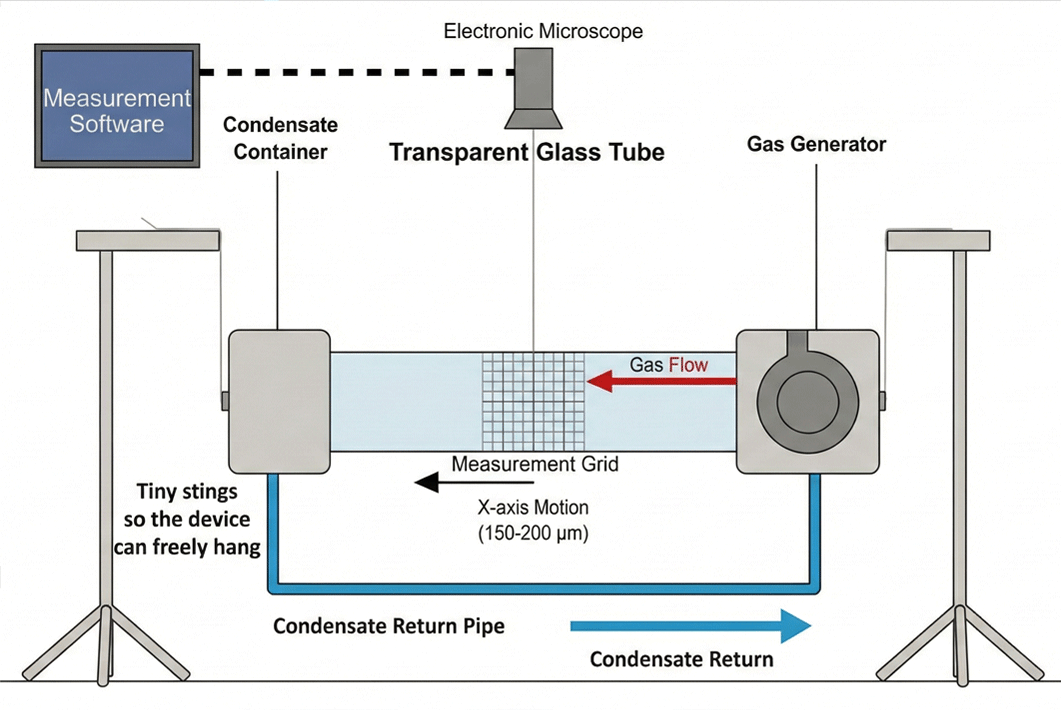
Verify the physical process representation of the phase-change reactionless drive using a macroscopic horizontal demonstrator.
Hypothesis
If the system operates as designed, it will generate a directed force resulting in measurable horizontal displacement that returns to equilibrium upon shutdown. This test is very important as it will shows that the system doesn’t need gravity to operate.
Experimental Setup
Environment: Isolated room with a vibration-isolated floor to exclude external noise.
Measurement device: Electronic microscope with measurement grid and computer tracking (template recognition).
Mounting configuration:
- Parallelogram mechanism supported by tripods for stability and minimal elastic deformation.
- Custom mounting assembly secures the gas generator and diffuser to the glass tube.
- Balance: Drain cap connected to a condensation container to maintain weight balance.
Procedure
Short Duration: 13-minute cycles (heater on first half, off second half).
Long Duration: 40-minute cycles (25 min heating, 15 min cooling) to reach steady state.
Thermal Monitoring: Recorded via thermal vision camera to verify gas distribution and seal integrity.
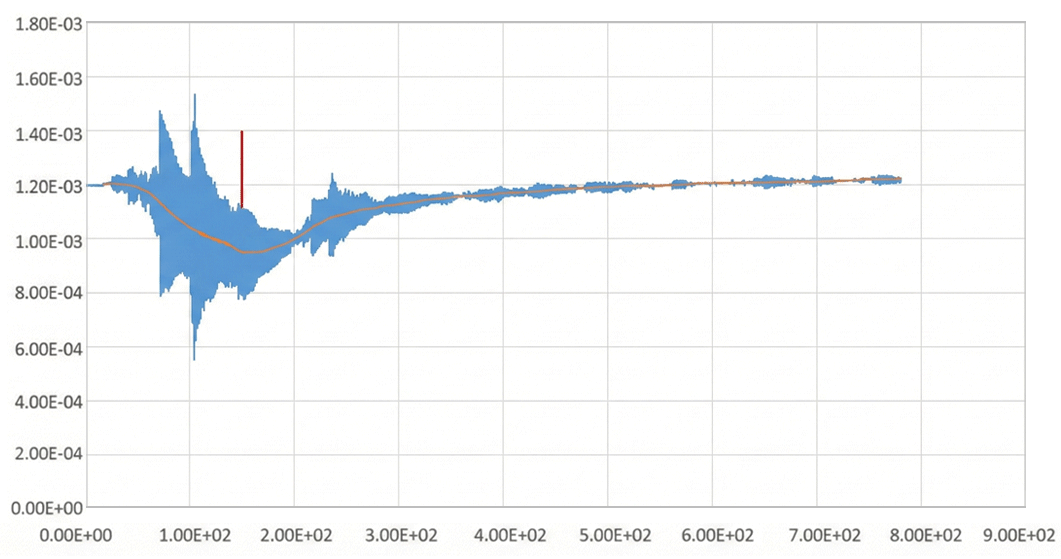
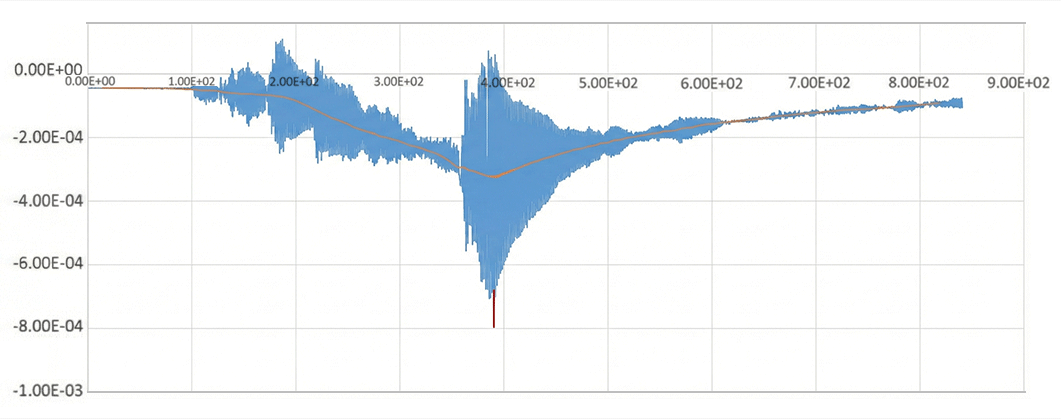
Graphs of the results
Results
Continuous thrust: ~50 mN (calculated unidirectional force)
Displacement: steady state deviation of 150-200 µm
System returns to initial position after shutdown (the red vertical line on the charts), confirming effect is not mechanical drift.
Thermal analysis confirms no gas leakage influenced the motion.
Conclusion
The experiment demonstrates a reactionless process with a calculated unidirectional force of ~50mN in a horizontal configuration.
The system reaches a steady state deviation while active and returns to zero after the shutdown, distinguishing the force from interference.
The system doesn’t need gravity to operate.
EXPLORE
The Astrum Drive generates a small but continuous, fuel-free acceleration that allows spacecraft to build up significant speed over time. With this capability, missions that currently take many years with conventional propulsion could reach most planets in the solar system in under a year—enabling rapid logistics, fast exploration, and entirely new mission possibilities.
While the commercial version of the Astrum Drive is still in development, we invite you to explore the solar system using our interactive simulator. Discover planets and moons, examine their surfaces, and get a glimpse of what fuel-free, continuous-acceleration propulsion will soon make possible.
For the best experience, please view this on a desktop or large-screen device using a mouse or pointer.
EXPLORE
The Astrum Drive generates a small but continuous, fuel-free acceleration that allows spacecraft to build up significant speed over time. With this capability, missions that currently take many years with conventional propulsion could reach most planets in the solar system in under a year—enabling rapid logistics, fast exploration, and entirely new mission possibilities.
While the commercial version of the Astrum Drive is still in development, we invite you to explore the solar system using our interactive simulator. Discover planets and moons, examine their surfaces, and get a glimpse of what fuel-free, continuous-acceleration propulsion will soon make possible.
For the best experience, please view this on a desktop or large-screen device using a mouse or pointer.
INVESTMENT OPPORTUNITY
Raising funds for Orbital Validation
We are raising funds to complete an in-orbit demonstration, the final milestone before commercialization.
This mission will allow us to confirm:
System behavior in sustained microgravity and vacuum.
Thermal and mechanical stability over long durations.
Scalability for operational satellite missions.
Use of Funds
Payload integration and flight preparation
Vacuum-optimized hardware and structural upgrades
Vibration and thermal improvements.
Orbital mission execution and post-flight data analysis.
Extend global patent coverage and strengthen IP protection.
Market & Commercial Potential
Satellite station-keeping and lifetime extension.
Orbital servicing, tug missions, and debris operations.
Deep-space and long-duration exploration missions.
Next-generation space logistics and infrastructure.
This mission is the final step before commercialization, raising the technology to TRL 9, and opening the gateway to deploying fuel-free propulsion across the space industry.
Our Board Members
Prof. Larry Louie
Board Member & Finance and Strategy
Financial governance, investor relations, and scale-up strategy.
Prof. Dr. Olaf J Groth
Board Member & Strategic Advisor
Strategic advisor focused on global partnerships, geopolitics, and commercialization strategy.
Jackie Space
Board Member & Government
Programs Advisor
United States Space and Air Force Veteran.
Jack R. Smith
Board Member & Strategic Advisor
United States Air Force Veteran, Space Force Association.
Prof. Dr. Eng. Georgi Todorov
Board Member & Engineering Advisor
Longest-serving dean at Technical University of Sofia, expert in advanced engineering and prototyping.
Our Board Members
Prof. Larry Louie
Board Member &
Finance and Strategy
Financial governance,
investor relations, and
scale-up strategy.
Prof. Dr. Olaf J Groth
Board Member &
Strategic Advisor
Strategic advisor focused
on global partnerships, geopolitics, and commercialization strategy.
Jackie Space
Board Member
& Government
Programs Advisor
United States Space and
Air Force Veteran.
Jack R. Smith
Board Member &
Strategic Advisor
United States Air Force
Veteran, Space Force
Association.
Prof. Dr. Eng. Georgi Todorov
Board Member &
Engineering Advisor
Longest-serving dean at
Technical University of Sofia,
expert in advanced
engineering and
prototyping.
We collaborate with experts from the following organizations










At Astrum, we’re paving the way for a new era in space exploration
Satellites that operate far longer, cost less to launch, and enable deep-space missions that are not feasible with today’s fuel-limited propulsion systems. Our next major milestone is an in-orbit demonstration of our propellantless, electricity-only propulsion system, the final step before commercialization.
Take the Next Step
Whether you’re an investor, engineer, or strategic partner, this is your opportunity to deepen your understanding and engage with us:
Learn More & Connect – Start a conversation about our technology, roadmap, and team.
Access Technical & Investment Resources – Request our technical overview, publications, and investment materials.
Schedule a Deep Dive – Book a session to explore mission fit, unit economics, or collaboration opportunities.
LATEST NEWS
ASTRUM DRIVE
AEROSPACE
SITE MAP
Headquarters
Dallas TX, USA
CONTACT US
contact@astrumdrive.com